

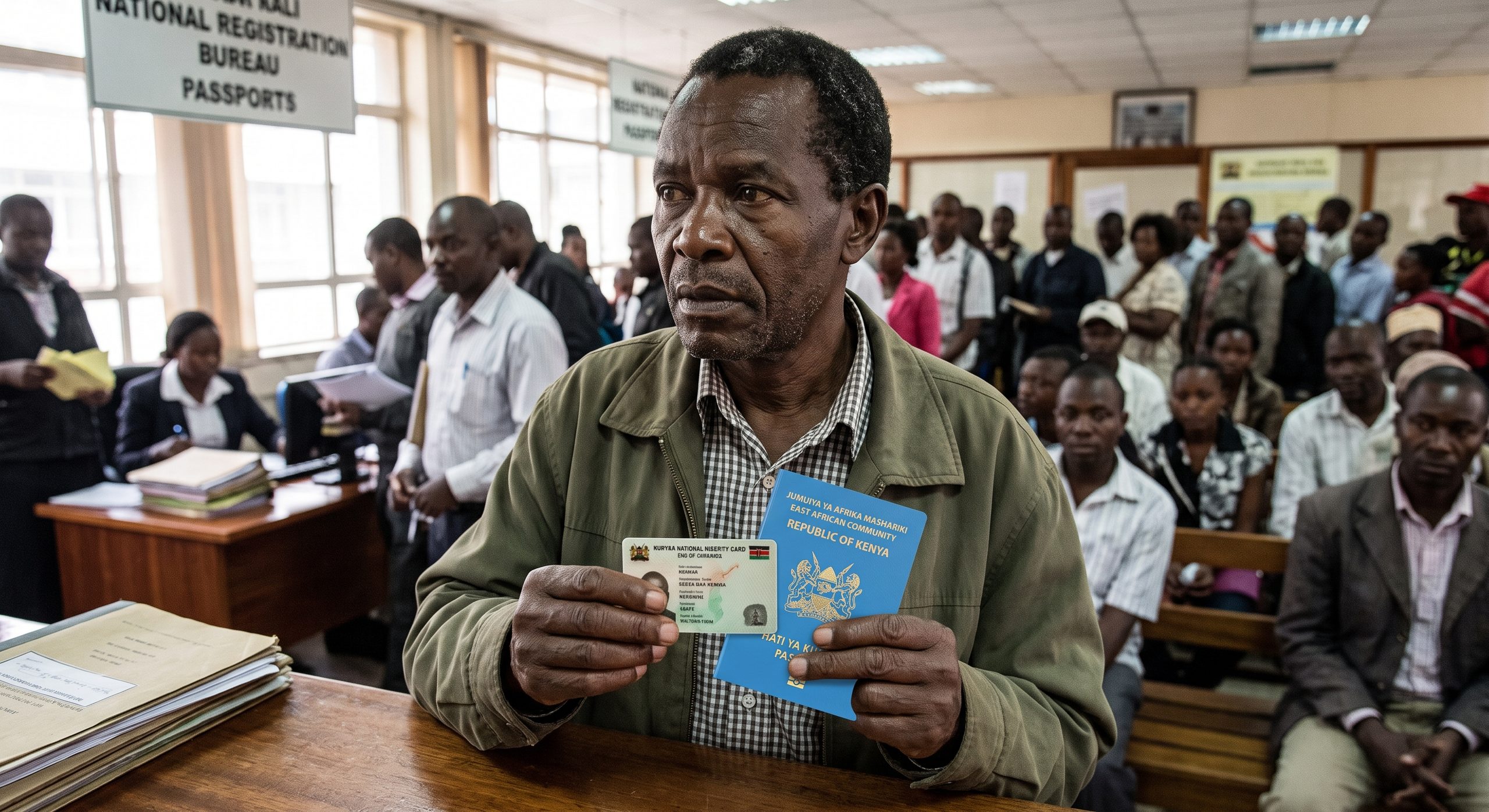
A passport is far more than a simple travel document. Within its pages lies the profound weight of a nation’s sovereignty, a symbol of trust between a state and the international community, and, most intimately, a declaration of a person’s rightful place in the world. When you hand over that little blue or black booklet at a border control desk in London, Washington, or Tokyo, you are essentially presenting a guarantee from the Republic of Kenya. The document says, “We know this person. They belong to us. We vouch for their identity and their integrity.”
But what happens when that trust is compromised? What happens when the very systems designed to protect the integrity of our national identity are breached, bypassed, or outright sold to the highest bidder?
Over the past few months, the nation has been gripped by a series of shocking revelations. Investigations and leaked documents have exposed a sprawling, deeply concerning syndicate where Kenyan national identity cards, birth certificates, and passports have been fraudulently issued to foreign nationals. For those of us who have spent our careers navigating the complex frameworks of immigration, diplomacy, and border control, these scandals are not just political talking points—they represent a fundamental crisis of national security and a betrayal of the legitimate citizens who endure grueling bureaucratic hurdles just to prove they exist.
The Frontlines of Nyayo House: A Look Back at 2019
To truly understand the gravity of the current situation, I find myself looking back at my own experiences. In 2019, I served as an attache at the State Department of Immigration. Walking the busy, often chaotic corridors of Nyayo House, one thing was unmistakably clear: the government was fiercely protective of the Kenyan passport. We operated under a strict, unyielding mandate to ensure that every single document issued ended up in the hands of a verified, legitimate citizen.
This rigor was especially pronounced when it came to applicants from border regions. I distinctly remember the extensive multi-agency vetting processes required for Kenyan Somalis applying for passports. The scrutiny was intense. It wasn’t just a matter of submitting a birth certificate and a national ID; applicants were subjected to rigorous interviews and deep background checks. Their entire family history was mapped and verified. Local chiefs, elders, and intelligence officers were all part of a synchronized effort to trace lineages and confirm local ties.
The logic behind this massive administrative apparatus was rooted in regional realities. Kenya shares long, porous borders with nations that have faced decades of instability. The fear was palpable: what if non-citizens—individuals who had perhaps crossed the border illegally or were seeking refuge—suddenly acquired Kenyan passports? What if individuals with ties to extremist groups or transnational crime syndicates managed to legitimize themselves through our civil registry? The vetting process, though undeniably slow, incredibly frustrating for legitimate applicants, and often criticized for its heavy-handedness, was viewed as a necessary fortress. It was the state’s primary defense mechanism against the erosion of its sovereignty.
We were taught that a single fraudulent passport could compromise the safety of millions. The integrity of the registry was paramount. Every file checked, every signature verified, was a brick in the wall of national security.
The Unraveling: Open Gates in the Current Era
Fast forward to the present day under the current administration, and the contrast is nothing short of jarring. The fortress we guarded so meticulously seems to have left its gates wide open. When the news broke that high-profile foreign figures, including a controversial Zimbabwean entrepreneur and senior figures from Sudan’s Rapid Support Forces, had seamlessly acquired Kenyan documents, I was astounded.
How could a system that once required a citizen from Garissa to bring their grandparents’ records suddenly issue a passport to an internationally sanctioned foreigner?
The recent undercover investigation by KTN News laid bare a syndicate that operates with brazen impunity. We watched in disbelief as brokers facilitated the sale of Kenyan IDs to laborers from neighboring countries for a mere KSh 15,000. We saw the national registry manipulated to show a single individual listed as the father of over a hundred people. The scrapping of the stringent, community-level vetting frameworks—once the cornerstone of our defense—has seemingly removed the very safeguards that kept the registry secure.
This is no longer a matter of administrative oversight; it is a systemic vulnerability. The immediate issuing of vital documents to individuals with zero historical or legal ties to Kenya is a direct threat to our sovereignty. It begs the question: if the state cannot reliably determine who is and who isn’t a Kenyan, what does it even mean to hold citizenship?
“The immediate issuing of vital documents to individuals with zero historical or legal ties to Kenya is a direct threat to our sovereignty. If the state cannot reliably determine who is and who isn’t a Kenyan, what does it even mean to hold citizenship?”
The Geopolitical Cost: When the Passport Loses its Power
In the realm of international relations and diplomacy, reputation is currency. A passport’s strength is measured by the trust other sovereign states place in its issuing authority. For years, the Kenyan passport has been one of the more respected travel documents on the African continent, allowing for relatively smooth mobility for business, education, and diplomacy.
However, when a nation’s documentation process is compromised, the global community reacts swiftly and decisively. Issuing passports and IDs indiscriminately carries catastrophic risks. If the wrong people—whether they be fugitives, sanctioned warlords, or individuals intending to commit acts of terrorism—travel the globe under the guise of Kenyan citizenship, the blowback will be devastating.
The world will simply stop trusting the Kenyan passport. We will see other nations imposing immediate, draconian restrictions on all Kenyan travelers. We do not have to look far to see what this looks like in practice. Consider the recent developments involving our neighbors in Uganda. The U.S. Embassy has reportedly required a staggering $10,000 security bond for some Ugandan citizens just to apply for a standard visitor visa. This kind of financial barrier is meant to act as an ultimate deterrent, rooted in a lack of trust in the applicant’s intent or background.
Imagine if Kenyan business owners, students, and tourists are suddenly subjected to similar blanket suspicions and prohibitive financial bonds worldwide. Imagine legitimate Kenyan travelers being repeatedly pulled aside for secondary questioning at global airports because our document is red-flagged internationally as “high risk for fraud.” The economic and social isolation would be paralyzing. By allowing our civil registry to be auctioned off, we are effectively jeopardizing the global mobility and dignity of over 50 million actual Kenyans.
The Unequal Burden: Punishing the Legitimate
Perhaps the most heartbreaking aspect of this entire crisis is the unequal politics of belonging it creates. This is where the tension becomes a critical human rights issue.
While well-connected foreigners and individuals utilizing corrupt brokers bypass the system with astonishing speed, the everyday, legitimate Kenyan citizen is left to carry the burden of the state’s suspicion. Because the system is now inherently compromised, the knee-jerk reaction of immigration and civil registration authorities is often to treat every genuine applicant as a potential fraudster.
This burden falls disproportionately on marginalized communities, minority ethnic groups, and those hailing from the very border counties that were historically vetted so heavily. A legitimate Kenyan citizen born in Mandera, Wajir, or Moyale still faces an uphill battle to prove their identity. They are subjected to administrative delays, demands for supplementary documentation that is often impossible to source, and a pervasive atmosphere of doubt.
They find themselves trapped in an agonizing paradox: the state demands proof of belonging that it simultaneously makes incredibly difficult to provide, while the back door is left wide open for those who can pay their way in. When a person’s citizenship is disputed, they are forced into a state of limbo. Without a valid ID or passport, they cannot open a bank account, register a business, apply for higher education, or secure formal employment. Their fundamental human right to an identity, and their ability to participate meaningfully in the economy, is stripped away.
Reclaiming Our Identity
The solution to this crisis cannot simply be a return to draconian, discriminatory profiling of our own citizens. Instead, we must demand absolute accountability and a modernized, corruption-proof infrastructure at the State Department of Immigration and the National Registration Bureau. The digitalization of records must be matched with unimpeachable cybersecurity and strict oversight to prevent the manipulation of databases from the inside.
At Millennia Immigration Consultancy, we deal with the complexities of global mobility every single day. We understand that a functional, secure immigration system is the backbone of a thriving nation. It facilitates trade, unites families, and opens doors to global education. But this is only possible when the foundational documents we rely upon mean something.
Kenya must protect the integrity of its citizenship. We must secure our borders and our registries not by alienating our own people, but by rooting out the syndicates that have turned our national identity into a commodity. The Kenyan passport must remain a document of pride, earned by birthright or legitimate naturalization, and respected across the globe.
It is time we ensure that when we ask, “Who belongs in Kenya?”, the answer is determined by justice, history, and law—not by the highest bidder.
Elizabeth Wambui Mumbi is an immigration consultant, international relations specialist, and the founder of Millennia Immigration consultancy, operating in Mombasa and Nairobi. For professional visa advisory, commentary, document legalization, and facilitation services, contact us at +254 708 603 007 or immigrationassistance254@gmail.com