

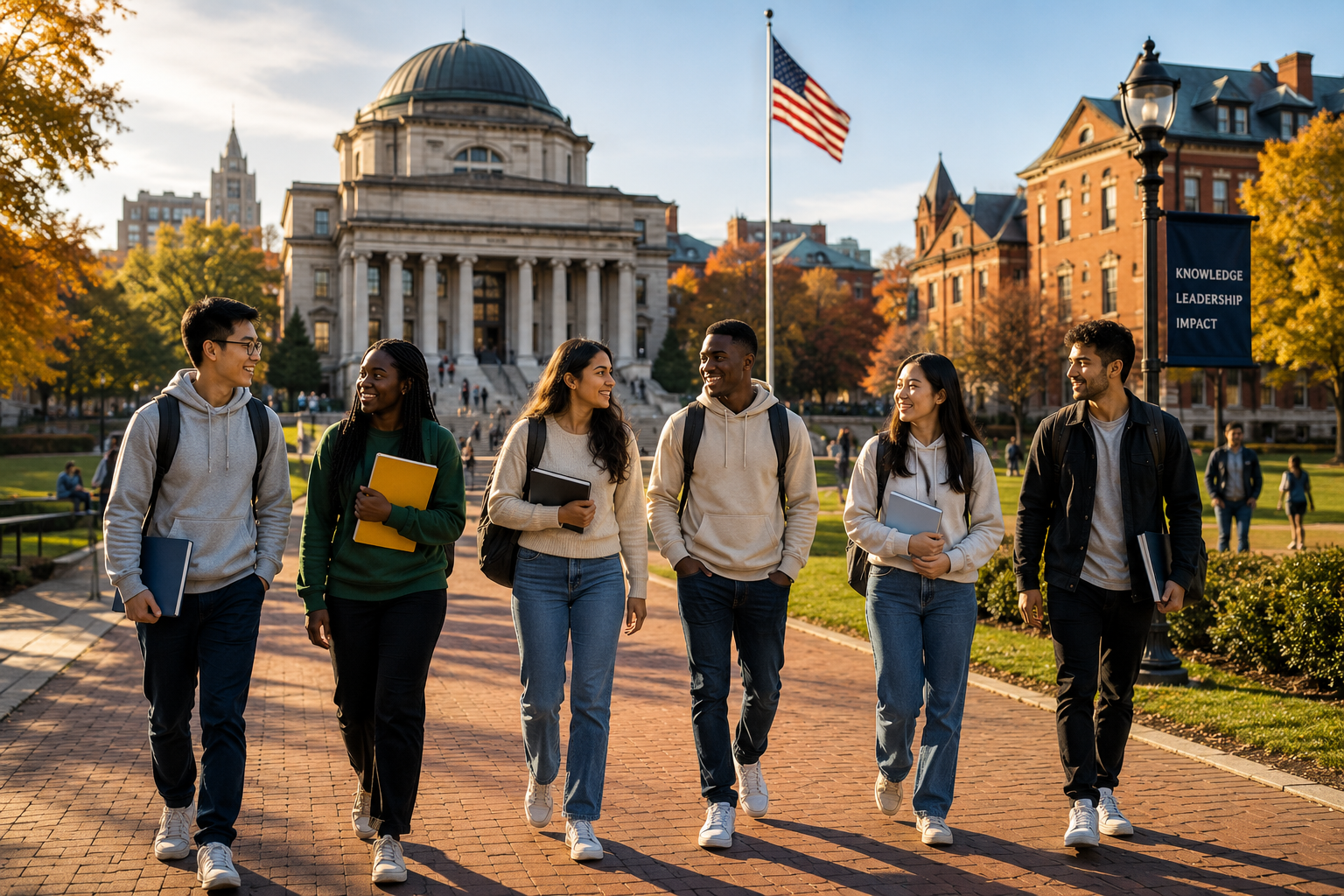
For many students around the world, studying in the United States is more than simply getting a degree.
It can represent an opportunity to access a different kind of education, build an international professional network, gain exposure to new ideas and technologies, and eventually return home with skills that can contribute to their communities and economies.
For students from developing countries, that opportunity can be particularly significant.
But in 2026, the decision to study in the United States is becoming more complicated.
The United States remains one of the world’s most important destinations for international education, and the U.S. government continues to state that it welcomes legitimate international students and exchange visitors. Students who wish to study academically or vocationally generally apply under the F or M visa categories, while exchange visitors may use the J visa category.
At the same time, however, the immigration environment surrounding international students has become considerably more restrictive and uncertain.
Visa screening has become more intensive. Online presence reviews have expanded. Some nationalities are subject to country-specific visa restrictions. And a major change to the way international students maintain their immigration status is scheduled to take effect in September 2026.
For students from countries where international education represents a major financial investment, these changes raise an important question:
Could changing U.S. immigration policies make studying in America more difficult, expensive or uncertain for students from developing countries?
The answer is not straightforward.
The policies are not specifically aimed at every student from a developing country, and students should not assume that studying in the United States is no longer possible. However, the environment is changing, and prospective students need to understand those changes before making decisions involving hundreds of thousands of dollars in tuition, accommodation and living expenses.
The United States remains an attractive destination
Before discussing the challenges, it is important to acknowledge why international students continue to choose the United States.
American universities are globally recognized, and the country offers a huge range of undergraduate, graduate, doctoral and professional programmes.
For students from Africa, Asia, Latin America and other developing regions, studying in the United States can provide access to programmes that may not be available at the same scale in their home countries.
There is also the attraction of the professional experience that can come after graduation.
For many students, the plan is not simply:
Study → graduate → leave.
Instead, it may be:
Study → gain practical experience → build professional skills → return home or pursue an appropriate long-term immigration pathway.
This is one reason immigration policy matters so much to international education.
A student doesn’t only choose a university.
They are also choosing an immigration environment.
If students believe that obtaining a visa will become extremely difficult, that they may not be able to complete their programme without additional immigration applications, or that post-graduation opportunities may disappear, they may simply choose another country.
That decision can have consequences for both the student and the United States.
Increased scrutiny of student visa applicants
One of the most visible changes is the expansion of visa screening and vetting.
The U.S. Department of State announced that F, M and J visa applicants are subject to online presence review. Applicants are instructed to make their social media profiles public or open so that the government can conduct the required review. The State Department says the purpose is to identify applicants who may be inadmissible and to determine whether applicants credibly qualify for the visa category they are seeking.
For a genuine student, this does not mean that having social media automatically makes them ineligible for a visa.
However, it does mean that prospective students should take their online presence seriously.
A visa application is no longer simply about the documents sitting inside an application folder.
The applicant’s overall circumstances and publicly available online information may also form part of the vetting process.
This is particularly important for young people who have grown up using social media as an informal space for expressing opinions, sharing political views, reposting content or discussing controversial subjects.
Students should not panic about this.
They should, however, understand that a U.S. visa application is a formal immigration process and that information provided during the application process needs to be accurate and consistent.
Country-specific restrictions create another layer of uncertainty
The second major issue is that U.S. immigration policy increasingly includes restrictions based on nationality.
In January 2026, a presidential proclamation resulted in full or partial suspension of entry and visa issuance for nationals of a number of countries. Among the countries subject to partial restrictions were several African countries, including Angola, Benin, Burundi, Côte d’Ivoire, The Gambia, Malawi, Mauritania, Nigeria, Senegal, Tanzania, Togo and Zambia. The restrictions included F, M and J student and exchange visitor visas for nationals of those countries.
This is particularly significant because it means that a student can potentially have an academic offer from a U.S. university and still face a separate immigration barrier based on their nationality.
That distinction is important.
Admission to a university and permission to enter the United States are two different processes.
A university may decide that an applicant is academically qualified.
The U.S. government ultimately decides whether that person qualifies for the appropriate immigration status or visa.
For students and families planning years in advance, that creates a difficult situation.
A student might spend months preparing applications, paying application fees, taking standardized tests, securing admission and arranging financing, only to discover that immigration policy has changed by the time they are ready to travel.
That is one of the biggest challenges created by rapidly changing immigration policy.
What about students from Kenya?
For Kenyan students, it is important not to assume that every restriction affecting African countries applies to Kenya.
Immigration policy needs to be examined country by country and visa category by visa category.
Kenya is not among the 19 countries listed in the January 2026 partial suspension described above.
However, Kenyan students are still affected by the broader changes in visa screening, appointment availability and immigration policy.
The U.S. Department of State has also announced a realignment of visa services in Africa to regional hubs, saying that the changes are intended to strengthen security screening, improve consistency and make operations more efficient.
For students, changes to where and how visa applications are processed can matter enormously.
University admissions follow academic calendars.
Visa processing follows government procedures.
If those two timelines do not align, a student can find themselves in an extremely stressful position.
Imagine receiving an admission letter for a programme beginning in August, paying a deposit and arranging accommodation, only to struggle to secure a timely visa appointment.
The student may then have to defer admission, lose money on arrangements or spend additional money changing flights and accommodation.
For families funding education from countries where foreign exchange rates can make U.S. tuition particularly expensive, these costs are not insignificant.
The biggest change: ending “Duration of Status”
Perhaps the most important change for international students in 2026 is the end of the long-standing Duration of Status, commonly called D/S, framework.
Historically, F-1 students admitted under D/S could generally remain in the United States while maintaining their student status and making normal progress toward completing their programme, including qualifying periods of Optional Practical Training.
That system is changing.
The Department of Homeland Security published a final rule in July 2026 ending D/S for F and J nonimmigrants and replacing it with a fixed admission period. The rule is scheduled to take effect on September 15, 2026.
Under the new system, international students will receive an admission period with a specific end date rather than simply being admitted for the duration of their status.
The new framework is particularly important for students whose programmes take longer than expected.
Consider a PhD student.
Research can take longer than planned.
A dissertation can require additional data collection.
A laboratory experiment can fail.
A supervisor can change.
A student can fall behind because of circumstances outside their control.
Under the new framework, students who need additional time may need to apply for a formal extension of stay with U.S. Citizenship and Immigration Services rather than simply continuing under the previous D/S system.
That creates additional administrative costs and uncertainty.
It also means students and universities will need to pay much closer attention to immigration deadlines.
Why this matters more for students from developing countries
At first glance, a change to immigration procedure might appear to affect all international students equally.
In reality, the consequences may be different depending on where a student comes from.
A student from a wealthy country may have parents or family members who can absorb unexpected immigration costs.
A student from a developing country may not have the same financial flexibility.
Imagine a Kenyan student whose family has spent several years saving for a master’s degree in the United States.
The family has paid university application fees.
They have paid the SEVIS fee and visa application fee.
They have arranged accommodation.
They have purchased health insurance.
They have paid a deposit.
Then the student discovers that they may need an additional immigration filing because their programme extends beyond their authorised period.
That additional cost may be manageable for one family and completely unaffordable for another.
This is why immigration policy should not be considered separately from economics.
The ability to move internationally is influenced by money.
And immigration policy can either reduce or increase the financial barriers involved.
The uncertainty surrounding Optional Practical Training
Another major issue is what happens after graduation.
Many international students choose American universities partly because they hope to gain professional experience after completing their studies.
Optional Practical Training, commonly known as OPT, allows eligible F-1 students to obtain temporary employment authorization for work related to their field of study.
For students in STEM fields, the STEM OPT extension can provide additional time.
However, the future of practical training has become a subject of significant policy debate.
The U.S. regulatory agenda continues to include changes relating to F-1 practical training, while the administration has also signaled interest in changing employment pathways available to foreign graduates.
There has also been public discussion about potentially imposing very large costs on foreign graduates seeking to work in the United States after completing their studies.
Some proposals reported in 2026 have involved a potential $100,000 fee connected to the employment of international graduates through OPT, although such proposals should not be treated as current law unless and until they are formally adopted.
This distinction is extremely important.
Immigration professionals and students should distinguish between:
proposed policy,
announced policy,
final regulations,
and
policy that is actually in effect.
Social media can make these categories appear interchangeable when they are not.
The psychological cost of uncertainty
There is another consequence that is more difficult to measure.
Uncertainty itself can influence student decisions.
Imagine being an 18-year-old student in Kenya deciding between universities in the United States, Canada, the United Kingdom, Australia and Europe.
If one country appears to have unpredictable immigration rules while another offers a clearer pathway from study to post-study work, the student may reasonably choose the country where they feel more secure.
This is not necessarily about which country has the “best” university.
It is about predictability.
International students and their families are making major financial decisions.
They want to know:
Can I get the visa?
Can I enter the country?
Can I complete my programme?
What happens if my programme takes longer?
Can I work legally while studying?
Can I work after graduation?
Can I remain in the country long enough to gain professional experience?
What happens if immigration policy changes while I am there?
When those answers become less predictable, students may reconsider their destination.
The United States also has something to lose
It would be easy to discuss these policies entirely from the perspective of students.
But there is another side to the story.
International students contribute significantly to American universities and local economies.
They pay tuition, rent apartments, purchase food, use transportation, buy goods and services and contribute to the communities where they study.
International students also contribute to research and innovation.
Universities rely on international students in many graduate programmes, particularly in areas such as science, technology, engineering and mathematics.
Recent analysis by NAFSA and JB International projected that declining international enrollment could result in up to 110,000 fewer international students in fall 2026, with an estimated $3.4 billion reduction in local economic spending and more than 39,000 jobs affected. These are projections rather than final outcomes, but they illustrate the economic stakes involved.
This creates a policy tension.
The United States has legitimate interests in national security, immigration compliance and ensuring that people entering the country genuinely qualify for their visas.
At the same time, universities want to attract talented students from around the world.
Students want predictable immigration rules.
Businesses want access to skilled graduates.
And local economies benefit from international students.
Finding the balance between these interests is therefore not simply an immigration issue.
It is also an education, economic and foreign-policy issue.
Could students simply choose another country?
Yes.
And this may ultimately be one of the most important consequences of increasingly restrictive immigration policies.
International education is competitive.
The United States is not the only country offering world-class universities.
The United Kingdom, Canada, Australia, Germany, France and other countries are also competing for international students.
When students compare destinations, immigration policy is part of the decision.
A university may be academically excellent, but if the student believes that obtaining the visa will be extremely difficult or that their post-graduation options are too uncertain, they may choose another destination.
This is particularly relevant to developing countries because international students often make decisions based on the entire return on investment of their education.
The cost of a U.S. education can be substantial.
Students therefore have to consider not only the academic value of the degree but also the professional opportunities available afterward.
What should prospective international students do?
The current environment does not mean that students should abandon their plans to study in the United States.
It means they need to plan more carefully.
1. Check the latest immigration rules
Do not rely on a TikTok video, WhatsApp message or an old blog article written three years ago.
U.S. immigration policy is changing quickly.
Always verify important information through official U.S. government sources and your university’s international student office.
2. Apply early
Visa appointment availability can vary, and students need to account for possible processing delays.
The U.S. Department of State advises students to apply early and notes that appointment wait times vary by location, season and visa category.
3. Understand your F-1 status
Obtaining an F-1 visa is not the end of the immigration process.
Students need to understand the conditions of their status, maintain the requirements of their programme and stay in contact with their Designated School Official.
4. Budget for unexpected immigration costs
Students should not plan their entire education budget down to the last dollar.
Changes to immigration rules can result in additional applications, legal advice, travel, document processing or other expenses.
5. Think beyond admission
Getting into a university is only one part of the decision.
Students should ask:
What happens after graduation?
If gaining U.S. work experience is an important part of the plan, students should understand the current rules governing OPT and any subsequent employment pathways.
6. Have a Plan B
This may sound pessimistic, but it is simply sensible planning.
Students should consider alternatives.
Could they defer admission?
Could they study in another country?
Could they transfer?
Could they complete part of their programme elsewhere?
Could they return home after graduation?
A good international education plan should not depend on one immigration outcome.
What does this mean for African students?
For African students in particular, these developments raise a much larger question about global mobility.
For decades, international education has been one of the pathways through which young Africans gain access to international professional networks, advanced training and global employment opportunities.
But the ability to participate in that system is not determined by academic qualifications alone.
It is also determined by immigration policy.
A brilliant student can have excellent grades, a scholarship and admission to a top university and still face an immigration system that determines whether they can actually travel.
This is why discussions about international education should include migration policy.
It is also why African governments, universities and students need to pay attention to changes happening in major destination countries.
If one destination becomes less accessible, students will look elsewhere.
And that could gradually change the global geography of international education.
A changing global competition for talent
There is a bigger picture here.
Countries are competing for international students because today’s international student can become tomorrow’s researcher, entrepreneur, doctor, engineer, academic or business leader.
A student who studies abroad builds relationships.
Those relationships can continue for decades.
Universities understand this.
Governments understand it.
Businesses understand it.
That is why immigration policy can have consequences far beyond the individual visa applicant sitting at a consular interview.
When a country makes it easier for international students to study, work and build legitimate careers, it becomes more attractive.
When the process becomes unpredictable, students have alternatives.
The United States therefore faces a difficult balancing act.
It has every right to protect national security, enforce immigration law and carefully vet visa applicants.
But it must also consider the consequences of making the international education system unnecessarily difficult to navigate.
The bottom line for students
The United States remains a major destination for international education.
But 2026 is not the same immigration environment that students were navigating several years ago.
Visa screening has become more intensive.
Some nationalities face country-specific restrictions.
Online presence review has expanded.
Visa processing arrangements are changing in parts of Africa.
And from September 15, 2026, the U.S. is scheduled to replace the long-standing Duration of Status framework with fixed admission periods for F and J nonimmigrants, although the rule is currently being challenged in court.
That does not mean international students cannot study in America.
It means planning has become more important.
Students should research their universities carefully, understand their visa category, monitor policy developments and avoid making major financial commitments based on outdated immigration information.
Most importantly, students should understand that university admission and immigration approval are two separate decisions.
An admission letter is an academic achievement.
A visa is an immigration decision.
Both are necessary for most international students who want to study in the United States.
Looking ahead
The most interesting question may not be whether international students will continue going to the United States.
They certainly will.
The more important question is how many students who once would have chosen America will now choose somewhere else.
If international students begin viewing countries such as Canada, the United Kingdom, Australia or European countries as offering more predictable pathways, the consequences could extend beyond individual students.
Universities could lose revenue.
American communities could lose economic activity.
Businesses could lose future talent.
And the United States could lose some of the international relationships that have helped maintain its position as a global education and innovation leader.
For students from developing countries, meanwhile, the stakes are deeply personal.
An international education may represent years of savings, family sacrifice and a once-in-a-lifetime opportunity.
That is why immigration policy matters.
It is not simply about visas.
It is about who gets to move, who gets access to opportunity, and how changing immigration policies shape the future of global education.
A note from Millennia Immigration Consultancy
Immigration policies can change quickly, particularly during periods of significant policy reform.
The information in this article is intended for general educational purposes and should not be treated as individual legal advice or a guarantee of visa approval.
Students considering study in the United States should verify the current requirements applicable to their nationality, visa category and circumstances before making financial or travel decisions.
At Millennia Immigration Consultancy, we believe that informed immigration decisions begin with understanding not only the application process, but also the wider policy environment in which that application is being made.