

By Wambui Mumbi
Immigration Practitioner and Researcher, Kenya
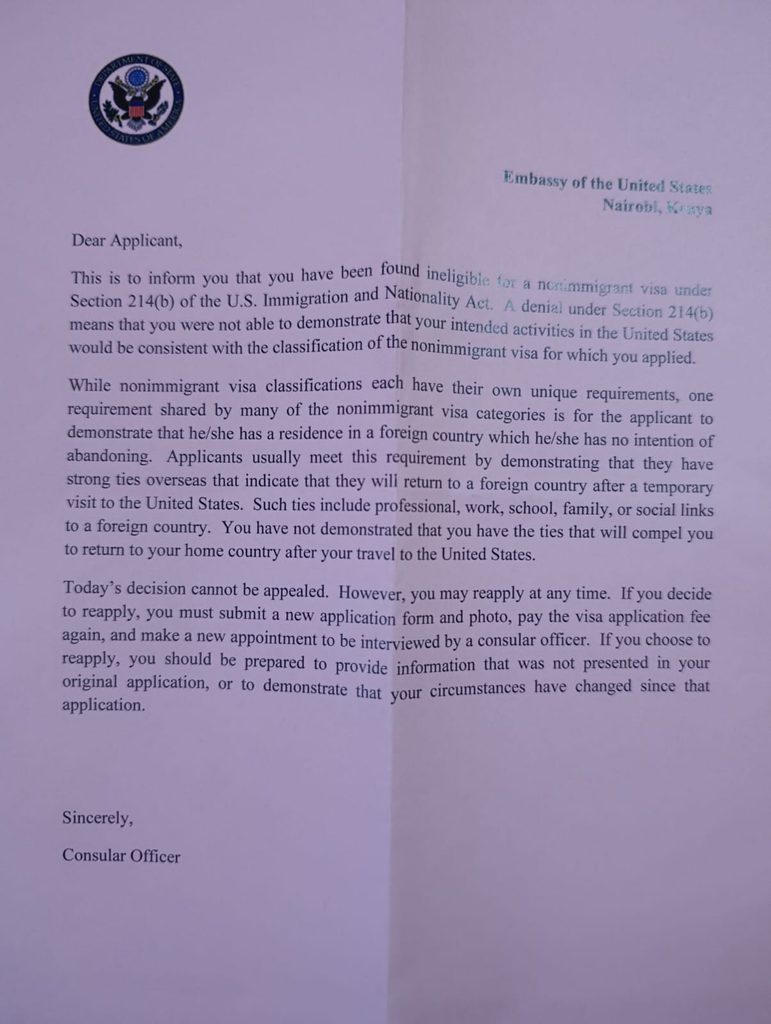
On October 1, 2026, I sat across from a U.S. consular officer at the Embassy in Nairobi, applying for a B1/B2 visa to attend a public lecture series on race and U.S. immigration law in Philadelphia. I was refused under Section 214(b).
I work in immigration. I know what 214(b) means. I know a nonimmigrant visa is not an entitlement, and that an officer has to be satisfied I intend to leave the U.S. after a temporary visit.
What I don’t know, and what nobody will tell me, is what was actually weighed in my case.
What the law says should happen
The State Department says an applicant must establish eligibility and overcome the presumption of immigrant intent. It describes “ties” as the things binding a person to their home country: job, home, family, relationships. It insists each application is considered individually, on its own circumstances, travel plans, finances and ties.
The Foreign Affairs Manual is just as explicit. A refusal has to rest on a legal ground, and for 214(b) refusals the Department’s own prescribed language cites professional, work, school, family and social links as the kinds of ties that matter.
Fine. That’s the framework. Here’s what actually happened.
What actually happened to me
I run Millennia Immigration Consultancy. I’ve built a career in this field. My trip had a direct, obvious connection to that career: a lecture series on immigration law, in a country whose immigration law I work in every day.
I was not asked what I do for a living.
I was not asked how long I’ve run my business.
I was not asked who was paying for the trip.
I was not asked how long I intended to stay, or where.
I was not asked why this lecture series, or how it connects to my work.
I was asked whether I’m married. Whether I have children. Whether I own or rent my homes. My travel history. When I graduated university.
Every one of those facts was already sitting in my application. The interview didn’t surface anything new, it just dwelled on the parts of my life that could be spun into “insufficient ties,” while the part of my life that actually explained the trip, my profession, went completely unexamined.
That’s not a technicality. That’s the entire ballgame.
I am not saying family ties are irrelevant
Let me be precise, because I don’t want this flattened into something it isn’t.
I’m not arguing an unmarried woman shouldn’t be asked whether she’s unmarried. I’m asking why being unmarried seemed to carry more weight than everything else I actually am.
There’s a lazy assumption baked into a lot of visa adjudication, that a young, unmarried, childless applicant must have weaker reasons to go home. But people build lives in every configuration imaginable: spouse, kids, business, career, aging parents, property, rent, community, all of it, some of it, none of it. There is no such thing as a “correctly tied” applicant. Real lives don’t exist to satisfy a checklist.
I’m 29. Unmarried. No children. I rent. None of that is a secret, and none of it erases the professional life I’ve spent years building in Kenya.
Picture a different applicant
Imagine a Kenyan doctor applying to attend a medical conference in Boston. Would it be reasonable to ask if she has a husband and kids? Sure. But wouldn’t you also expect the officer to ask what her specialty is, where she works, who’s funding the trip, how long she’ll be there, why she’s going?
I’m an immigration practitioner applying to attend a lecture series on immigration law. I expected at least a flicker of curiosity about that. I got none. That’s not me asking for special treatment, it’s me asking that the stated purpose of my trip actually be examined.
An interview, or an audition for failure?
This is the part that’s hard to say without sounding like I’m overreacting, so I’ll say it plainly anyway: the questions felt less like an attempt to understand why I needed the visa and more like a search for reasons to say no.
I can’t read anyone’s mind. I can’t prove intent. I won’t pretend otherwise, and I won’t invent a story I can’t back up.
But I can describe what it felt like, and what it felt like was a conversation built to find weakness, not to understand the whole picture. The State Department’s own materials say the officer’s job is to determine eligibility: purpose of trip, intent to depart, ability to pay. That’s what I expected the interview to explore. It mostly didn’t.
The question I’m allowed to ask, even without proof
I’m a young Black African woman. The officer who interviewed me was not. I was unmarried, childless, renting. I have no evidence that any of that shaped how I was read in that room.
I also have no obligation to pretend the question doesn’t exist.
Could age, gender, race, marital status or nationality quietly shape how “credible” an applicant looks to the person across the glass? I don’t know. I wasn’t given enough of an interview, or enough of an explanation afterward, to rule it out. That gap, not a verdict, a gap, is itself the problem. A process this opaque doesn’t just risk bias, it makes bias impossible to check for, which protects it either way.
Is there a quota? I don’t know, and that’s exactly the point
I’ve wondered whether Nairobi operates under some informal target. I have zero evidence that’s true. What I do have is a very short interview, a narrow set of questions, and no rationale I can test against anything. When an applicant walks away with that little, it’s not paranoid to ask how the system behind the glass actually works. It’s reasonable. The Department says every case is assessed individually. Then it should cost nothing to say so plainly, instead of leaving applicants to speculate in the dark.
I went looking for an answer. Here’s what I got.
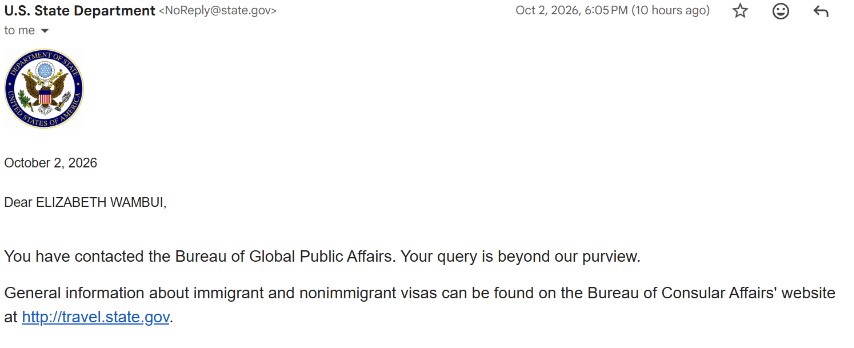
I contacted the Department of State directly to ask that my case be looked at. The reply, from the Bureau of Global Public Affairs, told me, verbatim, that my query was “beyond our purview.” I was redirected to travel.state.gov and a general phone line, with a note that immigration law specifically prohibits giving case-specific information to third parties.
I wasn’t asking as a third party. I was asking about my own case.
And if I want the actual consular notes behind my refusal, the thing that might tell me what was genuinely weighed, I’m told that means filing a request that costs money, with no guarantee it produces anything more than a form response. So the choice being offered to applicants is: accept a decision you can’t see the reasoning for, or pay to possibly find out why, with no promise the answer will be real.
That is not transparency. That is a toll booth in front of a locked door.
So here are my actual questions
Not rhetorical ones. Real ones, that I want answered.
Who is supposed to look at a case like mine? The Department says errors can be reviewed. By whom, under what trigger, and how would an applicant ever know to ask?
Why is there no appeal process for a 214(b) refusal? An applicant can reapply and pay again, but reapplying isn’t review. It’s a new roll of the dice with no acknowledgment the first roll might have missed something.
Can someone senior actually examine my case? Not a form letter. Not a redirect to a public website I’ve already read. An actual person, with the authority to look at what was and wasn’t considered.
I believe my application had merit. I believe the purpose of my trip was genuine, documented, and directly tied to my profession. I believe the interview I received did not seriously test that.
I refuse to become someone else to be believed
Do I need a husband before my travel is credible? Children? A house with my name on the title? Do I need to be 40 instead of 29? Would my application magically strengthen the day I acquire a spouse, and if so, what exactly is being measured, and does it have anything to do with the law at all?
I am already a professional. I already have work, responsibilities, a life I built myself in Kenya. That life doesn’t become more real the day I get married. It’s real now.
I will keep asking, whatever that costs me
I have decided to question this, to ask, to critique it publicly, even if doing so means the U.S. government quietly shadow bans me from future entry or marks my file in some way I’ll never be shown. The United States prides itself on being a country that champions freedom of expression. A system that only tolerates criticism from people it has already approved of is not actually practicing that value. I should be able to say what happened to me without that becoming evidence against me the next time I apply.
And I do not live in fear of that possibility. I am a Christian, and I hold onto 2 Timothy 1:7: that we have not been given a spirit of fear, but of power, love and a sound mind. My research career is only just beginning, and I will be applying again. Perhaps next time I will apply from a neighbouring country instead, Dar es Salaam, rather than walk back into that same room. What I will not do is pretend that interview wasn’t what it was. I don’t want to put myself through that kind of ritual again, the one that leaves an applicant feeling unworthy of travel, quietly suspected of something no one will name. And whatever happens with future applications, there is one person I never want to sit across from again.
This isn’t really about one refusal
Every immigration decision happens to an actual human being, not an abstraction. A few minutes at a window can carry real financial cost, real emotional weight, and real consequences for how someone understands their relationship with a country for years afterward. The Foreign Affairs Manual itself says how refusals are delivered affects how the U.S. is perceived abroad, and instructs officers to be courteous and careful.
That’s not etiquette. That’s supposed to be the baseline.
I’m not done asking
My complaint was never that the U.S. refused my visa. Sovereign states get to do that. My complaint is that I still don’t know why, that the one office I asked told me it wasn’t their problem, and that the only path to an actual answer runs through a paywall with no guaranteed outcome.
I can live with a decision I disagree with. I cannot pretend an opaque process felt fair when it didn’t.
I went to that embassy asking for permission to make a short professional trip. I left not knowing whether anyone had actually looked at who I am.
I’m still asking who’s supposed to.