

By Elizabeth Wambui Mumbi, Founder & Lead Consultant, Millennia Immigration Consultancy
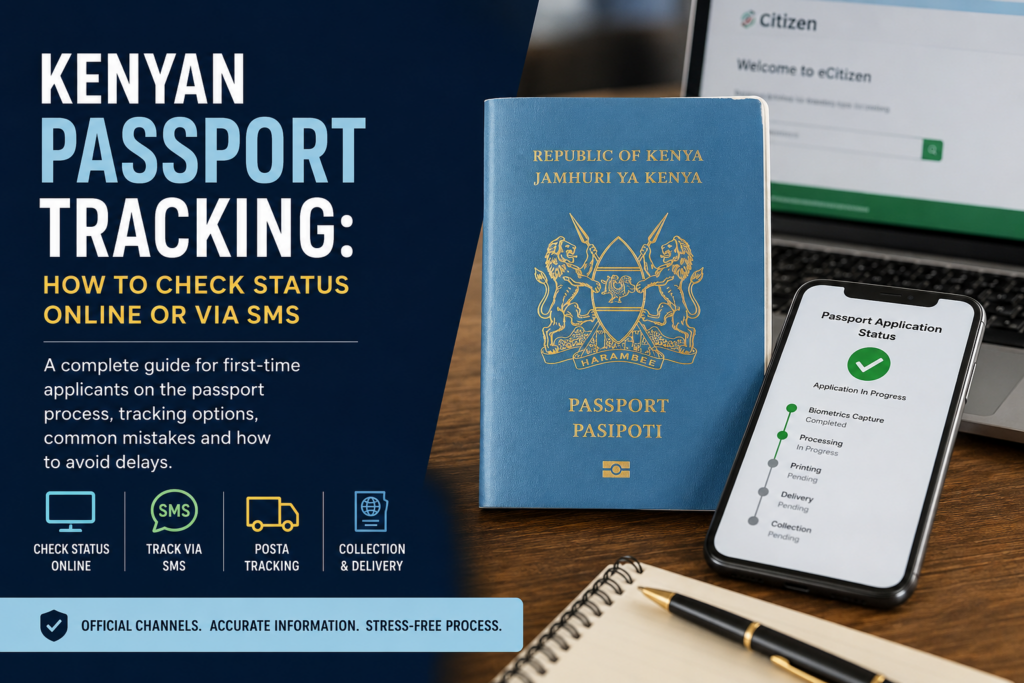
Getting a Kenyan passport is an important milestone for any citizen, whether it is your first passport, a renewal, or a replacement. For many applicants, however, the process does not end after submitting the application and attending the biometric appointment.
One of the most common questions we encounter is:
“How do I know what is happening to my passport after biometrics?”
The answer is passport tracking.
Once you have completed your application and biometric capture, your passport application moves through a number of stages before the final document is ready for collection or delivery. Knowing what those stages mean can help applicants understand whether their application is progressing normally, whether they need to provide additional information, or whether it is time to follow up with the relevant authorities.
I was recently invited by TUKO News to share my professional experience on Kenyan passport processing and tracking, including what first-time applicants should expect, how to distinguish a normal processing period from a potential problem, what to do when an application appears stuck, common mistakes that cause complications, and how applicants can protect themselves from people promising unofficial passport “connections” or expedited processing.
You can read the full TUKO feature here:
Kenyan passport tracking: How to check your passport status online or via SMS – TUKO News
As an immigration consultant and visa specialist, I believe passport applicants should understand the process rather than feel dependent on brokers or unofficial intermediaries.
This article expands on the points I discussed with TUKO and explains the passport journey from preparation and application to biometric capture, processing, printing and collection.
WHY PASSPORT TRACKING MATTERS
For a first-time applicant, the passport process can feel mysterious once the application has been submitted.
You have uploaded documents. You have paid the required government fees. You have attended your biometric appointment. You have left the immigration office with your tracking information.
Then what?
This is where tracking becomes useful.
Passport tracking gives applicants visibility into the progress of their application without having to repeatedly travel to an immigration office simply to ask whether the passport is ready.
The official systems can show the stage your application has reached and, where necessary, communicate whether further action or information is required.
According to the TUKO feature, applicants can track their passport applications through eCitizen, SMS and the Posta passport tracking service, depending on the status and delivery arrangements applicable to their application.
The key thing I tell applicants is simple:
Do not submit your application and forget about it. Keep your tracking information safely and monitor the application through official channels.
WHAT SHOULD YOU PREPARE BEFORE APPLYING FOR A KENYAN PASSPORT?
A smooth passport application begins before you create the application online.
One of the biggest mistakes applicants make is rushing into the online application before checking whether their supporting documents are complete, genuine and consistent.
For a first-time adult applicant, the relevant supporting documents can include the original birth certificate, original Kenyan national ID, passport-size photograph and other required supporting documentation.
Applicants may also need information and identification documents relating to their parents and guarantors, depending on their circumstances and the application requirements in force at the time of application.
Where a parent is deceased, the relevant death certificate may be required.
For minors, parental consent and the appropriate supporting documentation are particularly important.
The exact requirements can vary depending on whether you are applying for a first passport, renewal, replacement or on behalf of a minor, so applicants should always confirm the current requirements through the official Directorate of Immigration Service channels before submitting an application.
The most important principle is:
Get your documents right before you submit.
Do not wait until the biometric appointment to discover that there is a discrepancy between your documents.
KENYAN PASSPORT APPLICATION: THE PROCESS FROM eCITIZEN TO COLLECTION
The passport process begins online.
Applicants need to create and access their account through the eCitizen platform and access the relevant Directorate of Immigration Service.
The application is completed online and supporting documents are submitted as required.
After completing the online application and payment, the applicant books an appointment for biometric capture.
This is a critical part of the process because the applicant must physically appear at the designated immigration office.
For applicants in Nairobi, this may mean attending Nyayo House, while applicants in other parts of Kenya may attend the relevant regional immigration office.
Biometric capture is not something another person can simply do on your behalf.
Your physical presence is required.
Once biometric capture is completed, the applicant should keep their passport tracking information safely.
That tracking number becomes extremely important.
It is what allows you to monitor the progress of your application.
UNDERSTANDING THE STAGES OF KENYAN PASSPORT PROCESSING
Many applicants become anxious because they see a status such as “Processing” and do not know what it means.
The passport application does not go directly from biometric capture to a printed passport.
There are several steps involved.
The terminology displayed on the official systems can change or vary depending on the platform, but applicants will commonly encounter stages corresponding to biometric capture, processing, printing, delivery and collection.
- BIOMETRICS MODE
Immediately after biometric capture, the application may show a status associated with the biometric stage.
This essentially means that the applicant has completed the biometric capture stage and the application is moving into the next part of the process.
This stage is also important because issues with documentation or application information can sometimes be identified around the time of biometric capture.
For example, if information supplied in the application does not correspond with supporting documents, the applicant may be asked to correct or clarify the issue.
This is one reason I encourage applicants to prepare carefully before their appointment.
- PROCESSING
The processing stage is where much of the administrative work takes place.
The application and supporting information are reviewed and processed through the relevant immigration procedures.
An individual applicant’s information is associated with their immigration records and undergoes the necessary verification and approval processes.
The application may pass through different officers and stages of review before it is cleared for printing.
This is important to understand because seeing “Processing” does not automatically mean that something has gone wrong.
It may simply mean that your application is still moving through the normal administrative process.
- PRINTING
Once the application has passed the necessary processing and approval stages, the passport proceeds to printing.
This is the stage at which the physical passport booklet is produced with the applicant’s information.
Seeing a printing-related status is therefore generally a positive indication that the application has progressed substantially through the earlier stages.
However, applicants should still wait for the appropriate notification before travelling to collect the passport.
- DELIVERY
After printing, the passport moves into the delivery or dispatch stage.
For applicants collecting from an immigration office, the relevant notification will indicate when the document is available for collection.
The TUKO feature also discusses Posta’s passport tracking arrangements for applicants whose passports are being handled through postal delivery.
Applicants should therefore pay attention not only to the status shown online but also to any official SMS or notification they receive.
- DELIVERED / PICKED
Once the passport has been successfully collected or delivered, the status may subsequently reflect that the document has been delivered or picked.
For collection, applicants should carry the required original identification documents and relevant payment/application documentation as instructed.
Do not assume that because the passport has been printed you can simply walk into an immigration office and collect it immediately.
Wait for the official collection notification or instructions.
HOW TO TRACK YOUR KENYAN PASSPORT APPLICATION
There are several official ways applicants may be able to monitor their passport application.
- TRACK THROUGH eCITIZEN
The first option is the eCitizen portal.
Log into your eCitizen account and navigate to the Directorate of Immigration Service.
From there, you should be able to view the relevant passport application and its current status.
One of the advantages of eCitizen tracking is that you do not have to physically travel to an immigration office every time you want to know whether your application has progressed.
The TUKO feature notes that applicants can check their application status through their eCitizen account and that common status descriptions may indicate whether an application has been accepted, rejected or is ready for collection.
- TRACK BY SMS
SMS tracking can also be useful for applicants with pending passport applications or uncollected passports.
As reported by TUKO, applicants can send their eCitizen application reference code to 22222 to check the status through the available SMS service.
Because government digital services can be updated from time to time, applicants should always verify the current SMS procedure through official government channels before relying on it.
- POSTA PASSPORT TRACKING
Where the passport has been arranged for postal delivery, applicants may also be able to use the relevant Posta passport tracking service.
The TUKO feature explains that applicants can use the passport tracking number through the Posta passport portal to monitor delivery progress.
This is particularly useful because the applicant does not necessarily have to make repeated physical visits simply to find out whether a passport has been dispatched.
HOW DO YOU KNOW IF YOUR PASSPORT IS SIMPLY DELAYED OR IF THERE IS A PROBLEM?
This is one of the questions I am asked most often.
A passport remaining at one stage for several days does not automatically mean that there is a problem.
The processing system has multiple stages and applications can take different amounts of time depending on workload and operational circumstances.
For example, processing can be affected by:
High application volumes
Existing processing backlogs
Availability of passport booklets
Availability of particular passport series
Printing capacity
Technical issues affecting equipment
Maintenance or breakdown of printing equipment
Verification or administrative requirements
Additional information being required from the applicant
Therefore, an application remaining in “Processing” for a period of time should not immediately cause panic.
The more important question is whether the applicant has received an indication that something is wrong.
WHAT IF THERE IS A PROBLEM WITH YOUR APPLICATION?
Sometimes an applicant’s delay is not simply a backlog.
There may be an issue with the information or documentation submitted.
For example, there may be:
A discrepancy in names
Different spellings across documents
Incorrect personal details
Missing supporting documentation
Issues involving parental information
Problems with documentation for a minor
Questions regarding the authenticity or validity of a document
Information that needs clarification
This is why it is important to keep checking the official application status.
Where further information or documentation is required, the applicant may receive an indication through the relevant official system or be asked to take further action.
One of the most useful points I made during my interview with TUKO was that immigration processes are step-by-step processes.
In many cases, discrepancies are identified before an application progresses too far.
For example, documentation problems may be noticed around biometric capture or during the verification stages.
That means a request to correct something is not necessarily evidence that the entire application has failed.
Sometimes it is simply part of the process of ensuring the application is accurate before it moves forward.
WHAT IF MY KENYAN PASSPORT TRACKING STATUS DOES NOT CHANGE?
First:
Do not panic.
That is my advice to applicants who become worried after seeing the same status for several days.
The first step should be to continue checking the official tracking channels.
If the status remains unchanged for what you believe is an unusually long period, you can contact the Directorate of Immigration Service through its official communication channels or visit the relevant immigration office for clarification.
This is far safer than immediately approaching someone who claims they can “fix” the application.
Applicants should remember that passport processing is controlled by the government.
An unofficial broker does not suddenly acquire access to the internal immigration systems simply because they claim to have “connections”.
If you have a legitimate concern about your passport, go to the source.
WHY YOU SHOULD BE CAREFUL WITH PASSPORT BROKERS
This is an area where applicants need to be particularly careful.
Outside immigration offices, applicants may encounter individuals claiming that they can obtain a passport faster because they have “connections” inside government.
Some may promise:
Faster processing
Guaranteed approval
Immediate printing
Special access to immigration officers
“VIP” passport processing
Removal of a passport application from a backlog
Assistance that supposedly cannot be obtained through the normal process
My advice is simple:
Be extremely cautious.
The Directorate of Immigration Service is a large institution with many different functions and departments.
Even if somebody genuinely knows someone who works within government, that does not automatically mean that person has the authority or ability to manipulate a passport application.
A person who works in government is not necessarily a passport-processing officer.
And even where somebody has legitimate professional knowledge of immigration procedures, that does not mean they can guarantee an outcome or create an unofficial shortcut.
CAN SOMEONE REALLY “SPEED UP” YOUR KENYAN PASSPORT?
Applicants often ask this because they are travelling soon, have a job opportunity abroad, have university admission, or need their passport for a visa application.
The reality is that there is a difference between professional assistance and unofficial influence.
A legitimate immigration consultant can help you understand requirements, prepare your application properly, identify potential documentation problems and explain what steps you need to take.
That is very different from someone claiming:
“Give me money and I will make Immigration print your passport tomorrow.”
Applicants should be particularly suspicious of guarantees.
No legitimate consultant should promise a government-issued document on the basis of a supposed personal connection.
If your application is genuinely delayed, the appropriate approach is to establish why it is delayed and follow the official process for resolving the issue.
COMMON MISTAKES THAT CAN COMPLICATE A KENYAN PASSPORT APPLICATION
In my experience, many avoidable problems begin with documentation.
- NAMES DO NOT MATCH
One of the most important things applicants should check is consistency of names.
The names appearing on your birth certificate, national ID and other relevant documents should be consistent.
Even seemingly small differences in spelling can create questions that need to be resolved.
Do not assume that because the difference is only one letter it will automatically be ignored.
- SUBMITTING QUESTIONABLE OR INCOMPLETE DOCUMENTS
Applicants should use genuine and valid supporting documentation.
Do not submit altered, unclear, incomplete or questionable documents and hope that the issue will not be noticed.
Immigration authorities conduct verification processes, and documentation issues can affect processing.
- APPLYING WITHOUT UNDERSTANDING MINOR REQUIREMENTS
Applications involving children require particular attention.
Parents or guardians should ensure that the necessary consent and supporting documents are ready before beginning the application.
Family circumstances can also create complications.
For example, where a child’s birth certificate contains the father’s details but the father is no longer actively involved in the child’s life, applicants may need to address the relevant consent or documentation requirements before the application can proceed smoothly.
These are the kinds of issues that should ideally be identified before submission.
- ENTERING INCORRECT INFORMATION ONLINE
Applicants should carefully review the information they enter into the online application.
Do not rush through the form.
A simple error in personal details can create unnecessary complications later.
Review your information before submission and make sure it corresponds with your official documentation.
- LOSING YOUR TRACKING INFORMATION
Your tracking number is important.
Once you complete biometric capture and receive your tracking details, keep them somewhere safe.
Do not assume that you will remember the number later.
It is your reference for following up on the application.
WHY TRYING TO MANIPULATE THE PROCESS CAN ACTUALLY MAKE THINGS WORSE
There is another reason I discourage applicants from looking for unofficial shortcuts.
If multiple people start contacting different individuals about the same passport application, there can be confusion around who is following up, what information has been provided and what has been requested.
Applicants should resist the temptation to have numerous intermediaries “checking” their file.
The safest approach is to allow the application to move through the official process and follow up through the appropriate channels where necessary.
Sometimes the best thing you can do to avoid a delay is to stop trying to create one.
Let the system process the application.
WHAT CAN YOU DO TO MAKE YOUR PASSPORT APPLICATION AS SMOOTH AS POSSIBLE?
While no applicant can personally control every part of the government’s processing system, there are things you can control.
Before applying:
- Check the current official requirements.
- Gather all required documents.
- Ensure your documents are genuine.
- Check that names and personal details match.
- Ensure supporting documents are clear and readable.
- Pay the correct government fee through the official channel.
- Review your online application carefully before submission.
At biometric capture:
- Attend your appointment personally.
- Carry the required original documents.
- Listen carefully to any instructions given by immigration officers.
- If you are asked to correct or provide additional documentation, deal with it promptly.
- Keep your tracking information safely.
After biometrics:
- Monitor your application through the official tracking channels.
- Keep your phone number and contact information accessible.
- Do not ignore official notifications.
- If the status remains unchanged for an unusually long period, seek clarification through official channels.
- Avoid people who promise guaranteed shortcuts.
These simple steps can prevent many avoidable complications.
WHAT MILLENNIA IMMIGRATION CONSULTANCY CAN HELP WITH
At Millennia Immigration Consultancy, our work goes beyond simply filling in forms.
We help clients understand immigration processes, identify the documentation they need, prepare applications properly and navigate complicated immigration requirements.
Our services include immigration and visa consultancy covering areas such as:
Tourist and visitor visa applications
Business visa applications
Student visa guidance
Work and employment-related immigration
Family and dependent immigration
Residence and immigration status guidance
Permanent residence and citizenship application guidance
Business and investment immigration guidance
Kenya immigration and work permit assistance
Visa application preparation
Document verification and review
Passport and travel-document guidance
Schengen visa assistance
UK visa assistance
Australia and other international visa guidance
Kenya ETA and related travel-document assistance
For passport applicants specifically, our role is to help you understand the process and prepare correctly.
We do not claim to have secret government connections, and we do not promise guaranteed government outcomes.
That distinction matters.
A professional immigration consultant should help you navigate a process, not encourage you to bypass it.
THE DIFFERENCE BETWEEN LEGITIMATE IMMIGRATION ASSISTANCE AND A BROKER
This is particularly important in Kenya because immigration applicants can be vulnerable when they are under pressure.
Someone who needs a passport urgently may be willing to pay almost anything after hearing:
“I know someone inside.”
But before handing over money, ask yourself:
What exactly is this person doing for me?
Are they:
Helping you understand the requirements?
Reviewing your documentation?
Identifying errors before submission?
Helping you understand an official procedure?
Explaining what a particular immigration status means?
Helping you prepare an application?
Or are they simply claiming:
“I have a connection. Give me money and I will make the government process your document faster.”
Those are very different things.
A professional consultant’s value should come from knowledge, preparation, communication and guidance, not supposed secret access.
WHY APPLICANTS SHOULD USE OFFICIAL INFORMATION
Immigration requirements can change.
Fees can change.
Online systems can be upgraded.
Tracking procedures can change.
Collection arrangements can change.
For that reason, applicants should always verify current government requirements and procedures rather than relying on an old social-media post, WhatsApp forward or advice from someone who “did it three years ago.”
Even professional immigration consultants need to keep up with changes.
The role of a good consultant is not to pretend that government procedures never change.
It is to help clients understand what the current requirements mean and prepare accordingly.
YOUR PASSPORT IS MORE THAN A TRAVEL DOCUMENT
A passport represents something important.
It is a document that enables a Kenyan citizen to travel internationally and access opportunities abroad, whether those opportunities involve education, employment, business, family, tourism or other legitimate purposes.
That is why delays can be extremely stressful.
Someone waiting for a passport may be waiting for a university opportunity.
They may have received a job offer.
They may be preparing a visa application.
They may need to travel to visit family.
They may have a business trip coming up.
They may simply want the freedom to travel internationally.
I therefore understand why applicants become anxious when their status does not change immediately.
But anxiety should not make you vulnerable to scams.
FINAL ADVICE TO KENYAN PASSPORT APPLICANTS
If I could leave applicants with only a few pieces of advice, they would be these:
Prepare before you apply.
Do not rush into the application without checking your documents.
Check consistency.
Names and personal information should correspond across your supporting documents.
Keep your tracking number.
You will need it to monitor your application.
Use official tracking channels.
Check eCitizen and the other official channels available for your application.
Do not panic over every delay.
An application remaining at one stage for several days does not necessarily mean something has gone wrong.
If there is an issue, deal with it promptly.
If immigration requests additional information or documentation, respond appropriately.
Do not pay strangers to “use connections”.
A person standing outside an immigration office promising to produce your passport faster should be treated with caution.
And perhaps most importantly:
Do not allow urgency to make you vulnerable.
If you are genuinely concerned about your application, contact the Directorate of Immigration Service through its official channels or visit the relevant immigration office.
If you need professional guidance, speak to a reputable and trustworthy immigration consultant who can explain the process and help you prepare properly.
FROM PASSPORT APPLICATIONS TO INTERNATIONAL TRAVEL
For many Kenyans, obtaining a passport is only the beginning.
Once you have your passport, you may be planning to study abroad, work overseas, visit family, attend a conference, relocate, start a business, or simply explore another country.
That is where immigration and visa requirements become relevant.
A passport gives you the ability to travel internationally, but a passport is not itself a visa.
Different countries have different entry requirements, and some destinations require Kenyan citizens to obtain a visa before travelling.
The visa process may involve financial documentation, employment evidence, travel history, accommodation arrangements, travel insurance, invitation letters, proof of purpose, family circumstances and evidence that the applicant meets the relevant immigration rules.
This is where proper preparation becomes just as important as it was during your passport application.
At Millennia Immigration Consultancy, we help clients understand these requirements and prepare their applications with the bigger picture in mind.
THANK YOU, TUKO NEWS
I am grateful to TUKO News for the opportunity to contribute my professional perspective to its article on Kenyan passport tracking.
Being invited to discuss a subject that is directly connected to the work we do at Millennia Immigration Consultancy is an honour.
More importantly, it is an opportunity to remind Kenyans that immigration processes do not have to feel mysterious.
You have the right to understand the process.
You have the right to ask questions.
You have the right to use official government channels.
And you should never feel that you need to pay an unofficial intermediary simply to obtain information about an application that belongs to you.
The more applicants understand about the process, the less vulnerable they become to misinformation and exploitation.
ABOUT ELIZABETH WAMBUI MUMBI
Elizabeth Wambui Mumbi is the Founder and Lead Consultant of Millennia Immigration Consultancy, a Kenya-based immigration consultancy providing professional guidance on visa, immigration and travel-document matters.
Elizabeth has a background in International Relations and Diplomacy and has experience navigating immigration-related processes and assisting clients with international travel and immigration matters.
Her approach focuses on helping clients understand requirements, prepare appropriate documentation and navigate immigration procedures with greater clarity and confidence.
ABOUT MILLENNIA IMMIGRATION CONSULTANCY
Millennia Immigration Consultancy provides professional immigration and visa assistance to individuals, families, students, professionals, business travellers and other clients navigating international mobility.
Our services include visa application assistance, immigration consultancy, work permit and residence guidance, family and student immigration, business and investment immigration, document verification and travel-document guidance.
We believe professional immigration assistance should be based on knowledge, preparation, transparency and ethical practice.
We do not promise guaranteed visa approvals or unofficial shortcuts.
Instead, we help clients understand the process, prepare their documentation properly and make informed decisions about their immigration and travel plans.
Need help with an immigration or visa application?
Contact Millennia Immigration Consultancy to discuss your circumstances and the appropriate next steps.
Millennia Immigration Consultancy
Kenya
Website: millenniavisas.com
WhatsApp: +254 708 603 007
Email: immigrationassistance254@gmail.com
READ THE TUKO FEATURE
This article expands on my contribution to TUKO News’ feature:
“Kenyan passport tracking: How to check status online or via SMS.”
Read the full feature on TUKO News:
https://www.tuko.co.ke/268978-kenyan-passport-tracking.html
DISCLAIMER
Immigration and passport procedures, fees, processing times and digital services may change. Applicants should verify current requirements and procedures through the relevant official government channels before submitting an application. Information in this article is provided for general guidance and does not constitute a guarantee of processing time, passport issuance, visa approval or any other government decision.